

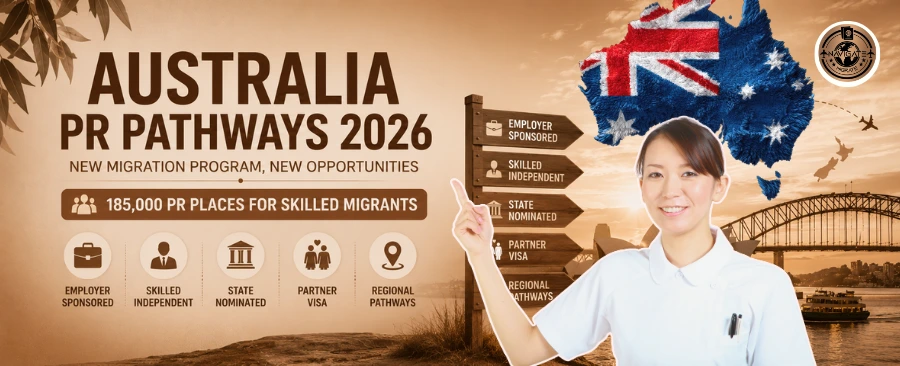
Australia has released the Australia Migration Program 2026–27, and while the total number of Australian permanent residency places remains steady at 185,000, the distribution of places across different visa categories has changed quite noticeably.
For anyone planning their Australia PR 2026 journey, this update is important because it gives a clear idea of where opportunities are increasing—and where competition may become tougher.
In simple terms, Australia is continuing to welcome skilled migrants, but the focus is shifting more towards Employer Sponsored Visa Australia pathways, especially the Subclass 186 Visa, rather than relying heavily on regional migration.
If you’re planning your move under the Australia Migration Program for 2026–27, it really helps to talk to someone who works with these cases every day. At Navigate Migrate, we guide people across the GCC on Australia PR 2026 options—checking eligibility, sorting documents, and figuring out which pathway actually fits your profile instead of guessing.
Here is a simple breakdown of how the planning levels have changed.
Visa Category |
2025–26 |
2026–27 |
Change |
|---|---|---|---|
|
Employer-Sponsored |
44,000 |
58,040 |
58,040 |
|
Skilled Independent (Subclass 189) |
16,900 |
21,090 |
+4,190 |
|
State/Territory Nominated (Subclass 190) |
33,000 |
35,500 |
+2,500 |
|
Regional Migration |
33,000 |
14,110 |
-18,890 |
|
Talent & Innovation |
5,300 |
3,500 |
-1,800 |
|
Total Skilled Program |
132,200 |
132,240 |
~Stable |
|
Partner Visa |
40,500 |
41,500 |
+1,000 |
|
Child Visa |
3,000 |
3,500 |
+500 |
|
Parent Visa |
8,500 |
7,060 |
-1,440 |
|
Other Family |
500 |
400 |
-100 |
|
Total Migration Program |
185,000 |
185,000 |
No change |
What stands out immediately is the sharp rise in employer-sponsored places and the significant drop in regional migration allocations.
Schedule a FREE consultation with Navigate Migrate to receive a customized plan based on the Australia work permit changes 2026.
If there is one clear takeaway from the Australia Migration Program 2026–27, it is this:
Employer sponsored Australia Visa is now the strongest pathway for Australian Permanent Residency in 2026. The allocation has increased to 58,040 places, which is a major jump compared to previous years. From what we are seeing in the market, Australian employers are still struggling to fill skilled roles in sectors like:
This is exactly why the government is leaning heavily on employer-sponsored migration.
One pathway that continues to gain importance is the transition from the Skills in Demand Visa (Subclass 482) to the Subclass 186 Visa.
This pathway is especially relevant if you are already working with an Australian employer or actively looking for sponsorship. To be honest, this is becoming the most realistic route for many skilled professionals in 2026.The Subclass 186 Visa is now not just an option—it is becoming the main PR target for many applicants on temporary visas.
The Subclass 189 Skilled Independent Visa has increased to 21,090 places, which is a positive sign for skilled workers who do not have employer sponsorship. But let’s be realistic—this is still a competitive pathway. Even though it is called “independent,” the reality is the following:
We continue to see invitations mainly going to occupations such as the following:
So yes, the pathway is open—but it is not easy.
The Subclass 190 Visa has also increased slightly to 35,500 places, and it continues to be a very practical option for many skilled workers.
In many cases, this visa becomes the turning point for applicants who are just short of 189 eligibility.
The key advantage is simple—state nomination gives additional points, and that alone can completely change your outcome.
That said, each Australian state has its own occupation list and selection criteria, so planning matters a lot here.
One of the most surprising changes is the sharp reduction in regional migration places—from 33,000 down to 14,110. This directly impacts pathways like:
What does this actually mean? In practical terms:
If your plan was fully dependent on Subclass 491, it may be time to reconsider your strategy or keep a backup option ready.
The Partner Visa Australia program continues to be one of the most stable parts of the migration system, increasing slightly to 41,500 places. For genuine couples, this remains one of the most secure routes to Australian Permanent Residency. But it is important to understand:
this is not just paperwork—it requires strong evidence of a real relationship.
The National Innovation Visa (Subclass 858) remains available, but with reduced allocation under the talent program. This visa is designed for individuals with exceptional achievements in areas like:
Business and entrepreneurship Research and innovation Sports Arts and creative industries
It is a niche pathway—not suitable for general skilled migration applicants.
Based on the current allocation trends, here is a practical overview:
Visa Pathway |
Outlook |
|---|---|
|
Subclass 186 Visa (Employer-Sponsored) |
Very Strong |
|
482 → 186 PR Pathway |
Very Strong |
|
Partner Visa Australia |
Stable |
|
Subclass 189 Skilled Independent Visa |
Competitive |
|
Subclass 190 State Nomination Visa |
Good Option |
|
Subclass 491 Regional Visa |
Weaker than before |
|
Subclass 858 National Innovation Visa |
Highly Selective |
The overall direction is quite clear—employer-sponsored migration is becoming the central focus of Australia’s skilled migration system.
If you are planning your Australia PR 2026 journey, this is the time to be strategic—not passive. Here’s what we usually advise applicants:
✔ Check your occupation eligibility. Not all occupations have equal chances anymore.
✔ Focus on skills assessment early. This is often where delays happen.
✔ Improve English score. Even a small improvement can change your points profile.
✔ Start exploring employer sponsorship. This is becoming the most realistic PR route.
✔ Don’t depend on a single pathway. Always have a Plan B (especially if targeting 189 or 491).
The Australia Migration Program 2026–27 confirms a clear direction:
Australia is still open to skilled migration, but it is prioritizing workers who can directly contribute to the workforce through employers. For many applicants, especially those exploring Australia PR from the UAE or GCC, this means one thing:
Employer-sponsored migration is no longer optional—it is becoming central. At the same time, opportunities still exist in skilled independent and state-nominated pathways, but they require stronger preparation than before. If planned correctly, 2026 can still be a forceful year for achieving Australian permanent residency.
At Navigate Migrate, we help skilled professionals choose the right migration pathway based on their profile, not guesswork. Whether you are considering:
We can help you understand your real chances and build a clear PR strategy.
Book a free consultation with Navigate Migrate, the best immigration consultants near you, and receive dedicated guidance across Abu Dhabi, Bahrain, Kuwait, Qatar, and Oman to help you plan your Australia PR journey with clarity and confidence.


Navigate Migrate
"Pathway to your Immigration dreams"