

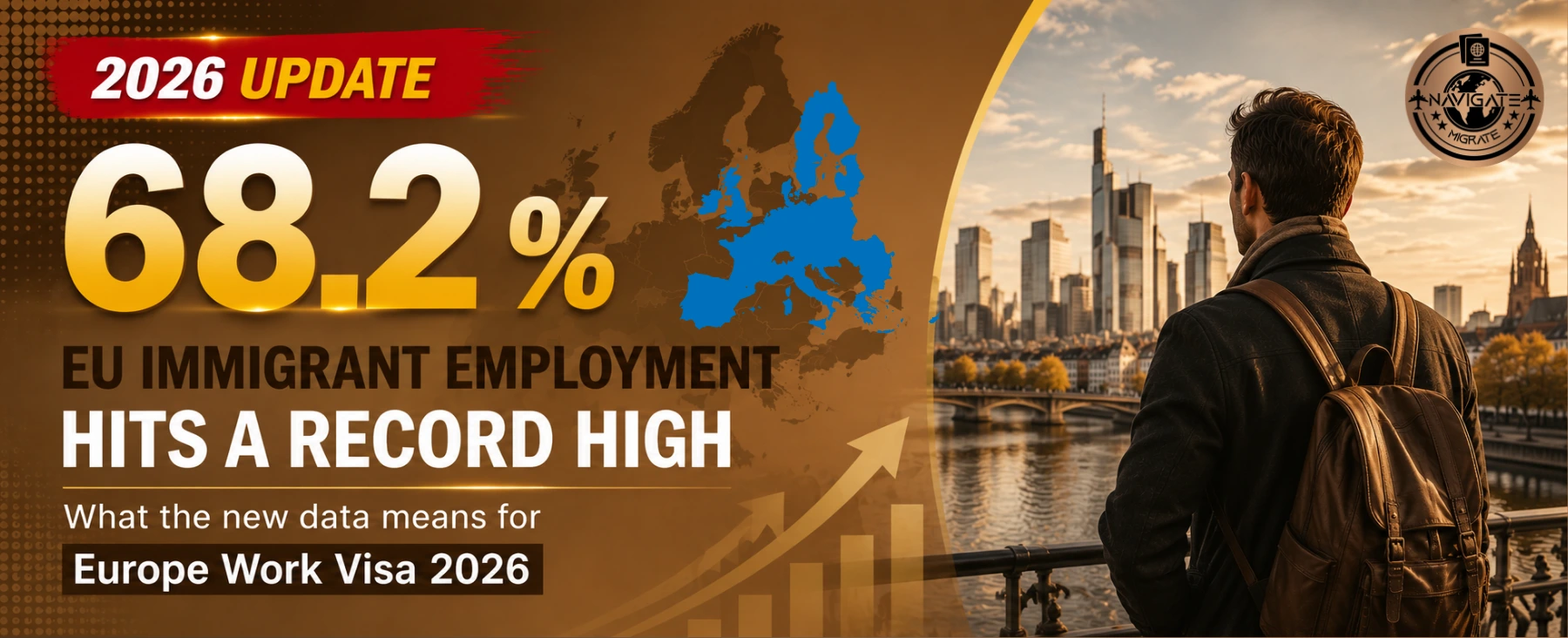
New research just handed anyone chasing a Europe work
visa in 2026 a genuinely useful data point. Immigrant employment across the
EU climbed to 68.2% last year — the highest figure since records began. Dig one
layer deeper, though, and the real story is about who’s driving that number.
Non-EU workers are. Their employment rate went from 59.4% in
2017 to 66.0% in 2025, a jump of 6.6 percentage points. Neither EU-born
immigrants nor native-born workers gained that much ground over the same
stretch. So if you’re applying from outside the bloc, you’re applying into a
labour market that’s been getting friendlier to you for the better part of a
decade — not a labour market doing you a favour, just one that increasingly
needs you.
This data comes from the Centre for Research and Analysis of Migration (CReAM), housed at the Rockwool Foundation Berlin (RFBerlin). Economists Tommaso Frattini and Giuseppe Pulito built it on Eurostat labour force figures stretching back to 2017, comparing outcomes for EU-born, non-EU-born, and native workers year by year.
If you want to see the methodology yourself, the RFBerlin research page is public. What follows here is what it actually means for someone weighing a move from the Gulf.
Not sure which European visit visa option is right for you? Talk to Navigate Migrate, the best consultancy in abu dhabi for europe.
Strip away the percentages and the explanation is simple: Europe doesn’t have enough workers of its own in specific industries, and that shortfall has become severe enough to reshape immigration policy itself.
Birth rates across much of the EU have been falling for years, and the workers retiring now aren’t being replaced one-for-one by new graduates entering the workforce. That imbalance compounds every year it goes unaddressed, which is roughly what’s been happening since the mid-2010s.
European hospitals are chronically understaffed, and it shows up hardest in nursing and elder care. Germany, Ireland, and the Czech Republic have each rewritten their credential-recognition rules over the last two years specifically so foreign-trained doctors and nurses can start working sooner rather than waiting out a lengthy verification process.
IT hiring isn’t a demographics story at all — it’s a training-pipeline story. European universities simply aren’t graduating enough software engineers, security specialists, and data professionals to match how fast those roles are multiplying. Interestingly, this is one of the few fields where a non-EU candidate and a local candidate are judged almost purely on ability, since the shortage cuts across nationality entirely.
Tourism-heavy economies lose hospitality staff constantly — the sector has one of the highest turnover rates in Europe, and fewer local workers are willing to take entry-level roles in it. Employers have responded by widening their hiring net well beyond national borders.
If you’re not sure which lane fits, our immigration consultants in Bahrain, Qatar, Kuwait, Oman and the UAE deal with this question constantly and can usually tell within a short conversation whether you need a Europe visit visa or something more like a Europe work permit.
Malta, the Czech Republic, and Ireland come out on top for non-EU employment outcomes in the CReAM data, while Belgium and Finland trail furthest behind. The researchers attribute most of that spread to two things: how demanding a country’s language requirements are, and how much flexibility its labour rules give employers hiring from outside the EU.
| Group | 2017 | 2025 | Change |
|---|---|---|---|
| Non-EU immigrants | 59.4% | 66.0% | +6.6 pts |
| EU-born immigrants | 71.1% | 74.8% | +3.7 pts |
| Native-born workers | 67.2% | 71.6% | +4.4 pts |
Germany is the clearest example of a country pulling in two directions at once. Its non-EU employment rate sits at 66.1%, well above the EU average — yet native-born employment is still nearly 14 points higher, at 79.6%. Demand hasn’t fully translated into parity. Notably, the researchers flagged that this gap is widest among highly educated migrants specifically, which points to something more nuanced than “can they get hired.” It suggests plenty of skilled non-EU professionals are landing jobs below their qualification level rather than struggling to land one at all.
None of this shortens the paperwork. You’ll still need a real job offer, a complete document set, and patience through the review window. What’s shifted is the probability that an application in healthcare, IT, or construction gets a serious look from an employer rather than getting buried.
We’ve noticed this pick up in real inquiries too — applicants across the UAE, Qatar, Kuwait, Bahrain, and Oman have been asking about Romania, Bulgaria, Serbia, Slovakia, and Croatia far more this year than in previous seasons, with construction and IT candidates leading that interest by a clear margin.
The mechanics stay roughly consistent regardless of which country you choose:
How long each stage takes depends heavily on which consulate you’re dealing with and how busy its current queue is.
Quotas and employer appetite shift monthly, so treat this as a starting point for narrowing your options rather than a fixed ranking.
| Country | Where the Jobs Are | What Tends to Slow Applications |
|---|---|---|
| Czech Republic | Manufacturing, IT, skilled trades | Documents submitted without certified translation |
| Romania | Manufacturing, construction, IT | Authentication steps on foreign paperwork |
| Serbia | Construction, hospitality, logistics | Employer-side paperwork gaps |
| Bulgaria | Manufacturing, agriculture, hospitality | Wrong permit category selected |
| Slovakia | Manufacturing, logistics | Employer registration hold-ups |
| Croatia | Hospitality, construction | Quotas that reset seasonally |
| Latvia | IT, logistics | Backlogs during peak filing months |
| Germany | Healthcare, engineering, IT | Sheer application volume |
Already leaning toward Romania? Our Romania work permit 2026 guide breaks down this year’s quota and typical timelines. Weighing Italy’s decreto flussi route instead? Here’s our full breakdown of the 2026 Italy work visa quota.
Every one of the countries above has its own rules, its own timeline, and its own document standards. Getting that right on the first attempt is usually what separates a permit approved within a few months from one that is stuck in review indefinitely.
Navigate Migrate works with applicants across Abu Dhabi, Qatar, Kuwait, Bahrain, and Oman to figure out which European route genuinely fits their background — then manages the documentation and submission from there.
Book a free eligibility check with Navigate Migrate and find out which country offers you the fastest realistic path to a Europe work visa in 2026.


Navigate Migrate
"Pathway to your Immigration dreams"